Longfellow
Nokomis
Nokomis

News for everyone, delivered to everyone
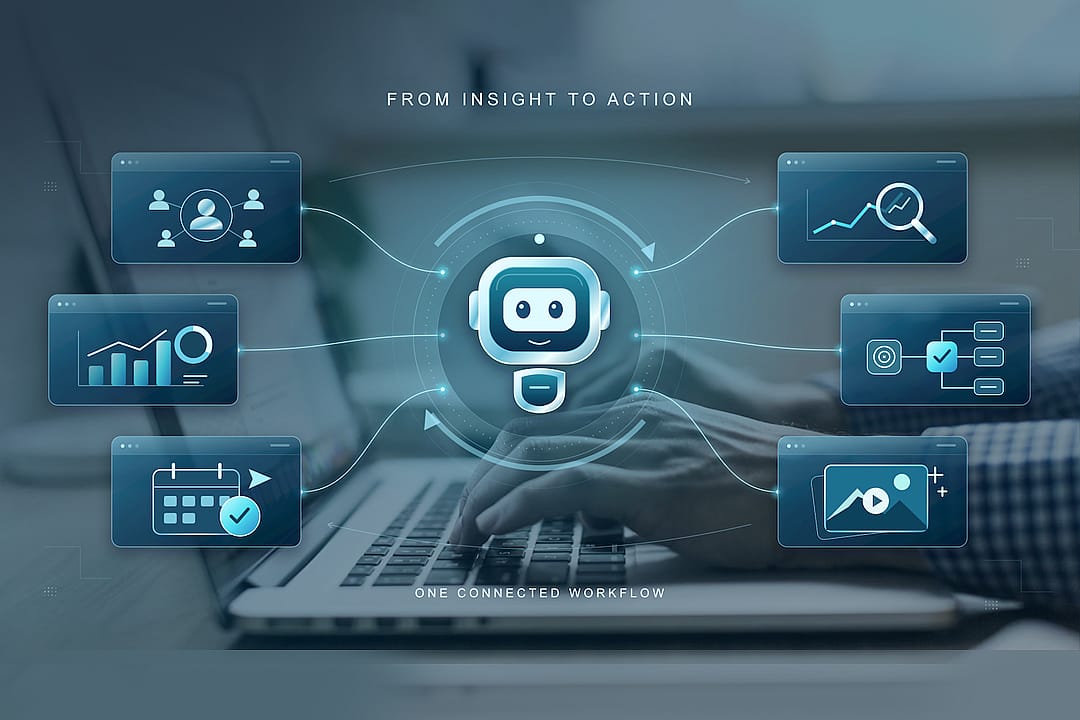

For social media managers handling multiple accounts, the difficult work often falls between tools. Audience research sits in one document, content plans in another, and performance data across several dashboards. Publishing connects these activities only superficially: a team can keep its calendar full while losing track of why a post was made or what its results should change.
AI is entering that gap. In her account of the 2026 Social Media Marketing World/AI Business World event in Anaheim, marketing professor Mary Beth McCabe highlighted agent autonomy, repeatable workflows and human leadership. The 2027 AI Business World program lists workflow automation and AI operations. The question is whether these systems connect evidence to decisions, rather than simply accelerate production.
AI should support human judgment, not replace it. By connecting strategy, content creation, publishing and performance analysis, AI could help teams streamline workflows, make better decisions and improve their results over time.
In this analysis, QuVideo examines how social media managers can use AI to streamline their workflows while keeping human judgment at the center of an increasingly automated process.
Data alone does not settle a social media decision. Sprout Social’s 2025 Impact of Social Media Marketing report describes data silos and the demand for audience and competitor context. Glimpse conducted the online survey for Sprout Social from May 30 to June 20, 2025, among 1,200 marketing leaders in the U.S., U.K. and Australia. Respondents ranged from managers to CMOs, all had social media responsibilities. Their responses highlight the need to connect social data with decisions across the business.
Even familiar metrics need interpretation. YouTube’s official guidance states that, from March 31, 2025, Shorts views counted starts and replays without a minimum watch time. “Engaged views” remained available as a separate metric. Comparing totals across that change could lead teams to mistake a measurement change for stronger content.
The goal of a campaign changes what a useful metric means. Reach can support awareness; inquiries require evidence of what people did afterward. Saves and comments may indicate interest, but neither automatically represents a qualified lead.
Providers approach these tasks from different directions. Buffer’s AI Assistant supports brainstorming, rewriting and adapting posts for individual platforms. AI Inspo’s AI agent brings personalized social media strategy, content creation, publishing and performance analysis in one platform for creators, marketers and businesses.
For teams choosing tools, the test is what survives from planning to review. Recommendations should retain evidence, briefs should identify their audience and purpose, and reports should address the question they were intended to answer.
Centralizing work also means deciding which account a recommendation concerns, who approves a post and whether the source data is current. Clear ownership makes it easier to revisit assumptions and correct them as accounts change.
San Francisco-based Plaid illustrates this connection. In a 2023 Sprout Social case study, social media lead Matthew McConnell described handling publishing, responses and reporting as a team of one. He tagged posts to compare performance, investigated weaker results and adjusted strategy for different audiences. For lean U.S. social teams, the practical lesson is to carry performance insights into the next content brief so that each round of publishing informs the next.
The same discipline applies to studying high-performing posts. Their success reflects an audience, a moment and a distribution history. Copying a format does not reproduce those conditions. A 2024 Science Advances study found that AI-generated ideas could improve evaluations of individual short stories while increasing their similarity among them. Although the experiment concerned fiction, social teams face a related challenge: testing original variations without narrowing the range of ideas.
Tutorials and comparisons can inform original work without copying another creator or assuming the same reach. Recording what changed and why makes results easier to interpret; changing several variables at once obscures the cause.
Research suggests that AI’s benefits vary by task and user. In Generative AI at Work, Erik Brynjolfsson, Danielle Li and Lindsey Raymond found larger gains among novice and less-skilled customer support workers, with minimal effects among experienced workers. A Harvard Business School field experiment likewise found that effects depended on the task. These findings suggest that task choice and human review matter alongside the tool itself.
Social media teams can assess that fit by comparing time spent on similar tasks, including review and corrections. Tracking audience response separately allows them to consider the time saved alongside engagement, inquiries and other outcomes relevant to their goals.
If a workflow reduces routine tasks, teams can devote more attention to choosing audiences, checking claims and deciding whether a trend fits their context. An AI social media agent should therefore be assessed on more than output volume: can the team explain why it created a piece of content, what happened after publication and what the evidence justifies trying next? The value lies in making the next decision better informed.
This story was produced by QuVideo and reviewed and distributed by Stacker.


