Longfellow
Nokomis
Nokomis

News for everyone, delivered to everyone


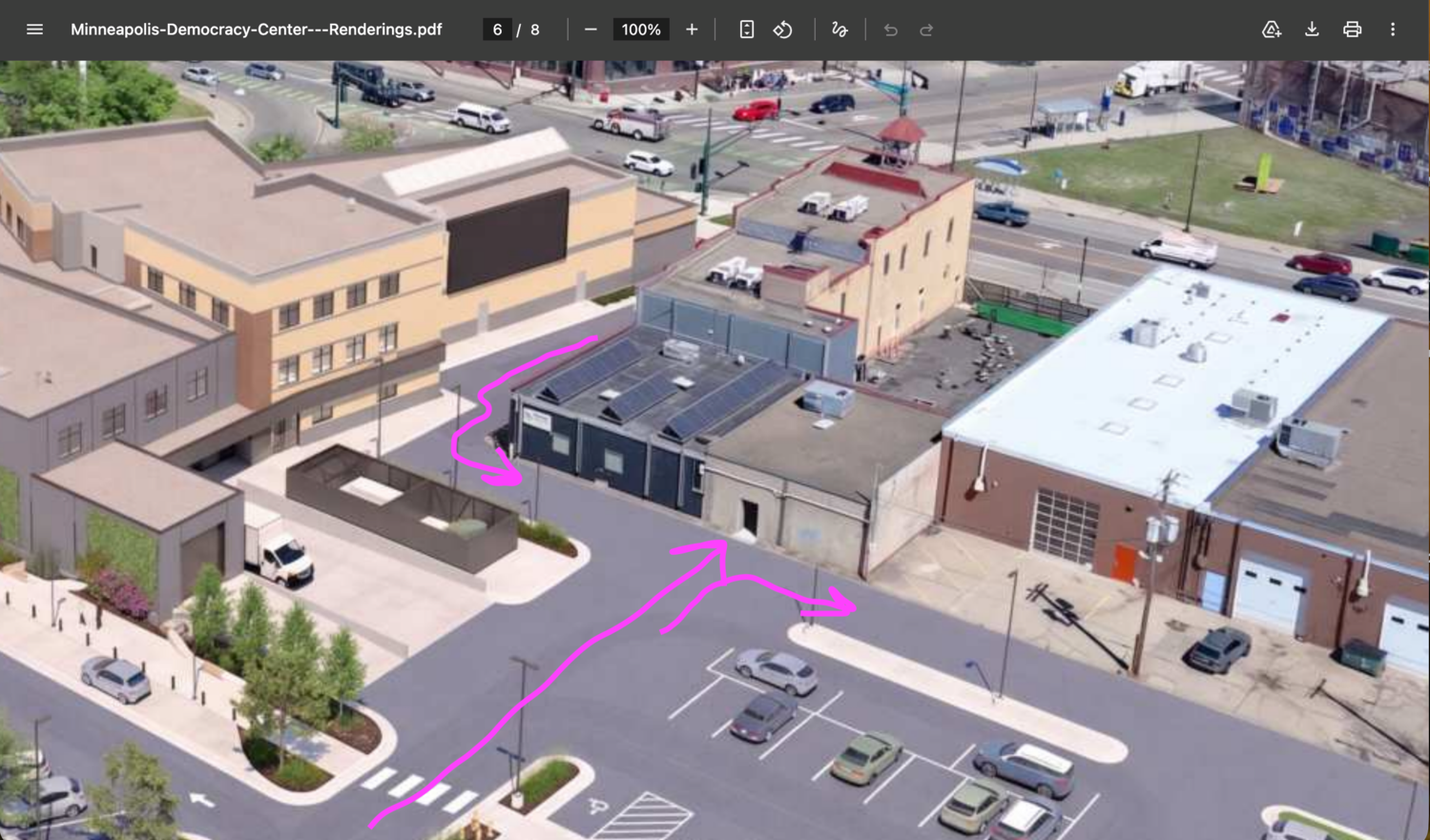


The Minneapolis City Council has approved the plan for the renovation and expansion of the old Third precinct police station at 3000 Minnehaha despite concerns about access and parking from area businesses and community members.
Local businesses had asked the city for an independent economic impact study to ensure that redevelopment strengthens, rather than unintentionally harms, one of Minneapolis' fastest-growing cultural destinations.
As they voted 12 – 0 to approve the site plan, zoning changes and conditional use permit on July 30, the city council also added new condition that will require the city’s property services department to consult with local businesses and implement a shared use parking agreement on the redeveloped surface parking lots. This had not been done on the “Democracy Center” project at the former Third Precinct.
The new condition was crafted and moved by Ward 12 Council Member Aurin Chowdhury, who unsuccessfully tried to delay the decision longer to address other concerns.
“It’s clear that the way the design is, is going forward,” said Chowdhury speaking directly to concerned community stakeholders at the council meeting. “I’m sorry that we haven’t been able to make more of a difference for you.”
The approved plan includes a two-story, 16,800 square-foot addition to the former police station at 3000 Minnehaha Ave and 3033 Snelling Ave. that will more than double the size of the existing building. This will serve as the city’s elections and voter services department headquarters, with offices, warehouse space and an early voting center. It also includes 8,000 square feet of the ground floor space set aside for yet to be determined community use.
ALLEY CLOSURE CRITICIZED
The alley vacation and reconfiguration was one of the most criticized aspects of the plan.
“The new plan eliminates straight access from the alley to the private drive and the several nearby businesses do not want any change to the existing alley and existing parking,” said Brian Walker, representing Hook and Ladder at the city council’s Business, Housing and Zoning Committee on July 21 where the appeal hearing was held.
“We are the remaining four businesses,” Walker added. “We do not want the Democracy Center to be the death of everything.”
Prior to that hearing, the project approvals were delayed at the City Planning Commission while efforts were made to address concerns raised by the neighboring businesses, but eventually the commission voted 4 to 3 vote to approve the conditional use permit, zoning changes, alley changes and site plan.
ELECTED OFFICIALS VOTE AGAINST AT PLANNING COMMISSION
All three of the Planning Commission members who are the elected officials who represent the area affected – Council Member Aurin Chowdhury, Park Board Member Jason Garcia and Hennepin County Commissioner Angela Conley – voted against the approvals at the commission.
Kristine Smith then filed the appeal on behalf of FG & C LLC, also known as the Hook and Ladder, that was heard and discussed at the council’s Business, Housing and Zoning Committee on July 21 where the matter was moved forward without recommendation despite council members Chowdhury and Ward 9 Council Member Jason Chavez asking not to move it forward in order to have time to better address concerns.
At the appeal hearing city staff shared changes they had made to the plan between the May and June planning commission meetings. While they did not adjust the plan to straighten the public alley and keep it aligned with the Hook and Ladders private drive, they did add space and changed it from a “L” turn to an “S” curve that they said would allow large trucks to safely make the turn.
This was accomplished by moving a generator and a transformer, widening the new curved alley to 32 feet, and moving a proposed garage closer to the new addition.
City staff, including city clerk Casey Carl and property services director Barbara O'Brien also warned council members that any further delays in the project would make it unlikely that the facility would be up and running in time for the 2028 election.
COMMUNITY MEMBERS CONCERNED ABOUT PLAN
Community members were also concerned as reflected in both written and spoken comments.
“We are glad finally to see movement on the renovation and reuse of the property at 3000 Minnehaha,” said Lisa Boyd who was representing the nonprofit organization Longfellow Rising. “For too long, it has been a symbol of stalled recovery and abandonment. However, this should not come at the expense of anchor businesses on Minnehaha Ave, especially the Hook & Ladder Theater, which is a destination in Downtown Longfellow and a cherished institution for musicians and music lovers across the metro.”
Boyd added, “I’m not a lawyer, but I can imagine the courts might decide that everything the City is planning to do at this site is perfectly legal. But just because it’s legal, and maybe it isn’t, it still doesn’t make it the right thing to do.”
Some local businesses, identifying themselves as the Longfellow Arts & Entertainment District, have called for an independent economic impact study to “ensure that redevelopment strengthens, rather than unintentionally harms, one of Minneapolis' fastest-growing cultural destinations.”
"We are not asking the City to choose between redevelopment and existing businesses," said The Hook & Ladder Event Center co-owner Chris Mozena before the final vote. "We are asking for a plan that successfully supports both."
The district includes The Hook & Ladder Event Center, Firehouse Performing Arts Center, Solcana Fitness, the future home of Pangea World Theater, Moon Palace Books, and Arbeiter Brewing. Business owners asked city leaders to consider modifications that preserve business access, maintain a connected alley, support shared public parking, and strengthen the district’s long-term economic vitality.
The Longfellow Business Association Board supported the requests of local businesses, asking that the city hold off on the project at its July board meeting.
"We all want to see this property brought back to life," said Jesse Brodd of the Hook and Ladder. "Redevelopment should build on the momentum already underway here. This neighborhood has become a destination for live music, the arts, local businesses, and community events. We believe the final plan can support new investment while protecting the businesses that helped carry this neighborhood through some of its most challenging years."
Chowdhury agrees, noting, “The community has been really coming together in downtown Longfellow to come back, be vibrant and strong.”
She is hopeful that the new condition will improve the level of engagement between the city and local businesses.
“We’re just not bringing enough people in the neighborhood together as we’re making these choices and decisions,” she said. “We have to change that going forward.”
“We are glad that the council approved the amendment for a shared parking agreement with area businesses, though still disappointed that there was not better engagement with them over the seven months – from October to May – that the site plans were being developed,” said Boyd following the council’s meeting. “We are grateful to Council Member Chowdhury for coming up with the compromise and we deeply appreciate her speaking on the pain this community went through in 2020.”
Boyd is convinced that a shared parking arrangement could be very beneficial.
“Shared paid parking around the district,” said Boyd, “would contribute directly to the revitalization and expansion of Downtown Longfellow into an arts and entertainment district with the opening of Square Roots restaurant at the Coliseum, the coming of Pangea World Theater, and the return of retail businesses along East Lake Street and 27th Avenue, once those properties are redeveloped.”


Comments
No comments on this item Please log in to comment by clicking here